Monday, May 27, 2013
Thematic Wanderings: Garden Of Guilt
Upon taking the much-neglected time to digest Zexcs's singularly unique TV adaptation of Shuzo Oshimi's Aku No Hana, it occurred to me that there are bizarre parallels to be made with a personal favorite Kurosawa film, which yields enough space for consideration of a certain societal focus. In the Flowers narrative, we have a bookish, socially withdrawn young man, Takao, who finds himself at the center of a gut-twisting after-school triangle as a sociopathic classmate threatens to out him for an indiscretion regarding his classroom crush, Saeki. Having been unable to resist the temptation to take her gym clothes home with him, the plaguing within his already troubled mind is exacerbated by the meeting of one Nakamura, a girl clearly overflowing with dangerous impulses, and even greater unpredictability, lets him into her lurid world under threat of exposure. All based on a single act, the three are eventually bound together in a cycle of ever intensifying psychosexuality, carrying implications not only for these characters, but perhaps all around them. But what really captured me about this lurid tale of young love gone horribly wrong, was how oddly it carries faint echoes of one of Japan's most enduring crime dramas, Akira Kurosawa's Stray Dog(1949).
As much a tale of the sprawling chaos of post WWII Japan as it is the tense drama of one young homicide detective's desperate search for his stolen firearm. As the harried former soldier, and greenhorn detective, Murakami, Toshiro Mifune portrays a man consumed by his own increasing sense of guilt over the loss of his Colt, carrying seven live rounds, now possibly in the hands of someone very dangerous. When he is offered the opportunity to join up with veteran detective, Sato (Takashi Shimura) to track down what could lead to a bust in the city's illegal gun trade racket, Murakami continues to lament and panic over what he feels if his own accidental complicity. While the more world weary Sato maintains belief that criminals are themselves far too gone, and therefore naturally evil, it is Murakami who finds himself empathizing with the explosion of criminality post war Japan has engendered. Endlessly worrying about his gun, and what has likely been done with it clouds his many decisions, and he eventually must grow to understand that his folly is something much smaller an element. As each lead and dead end takes the two cops toward their better understanding of the desperation inherent in Japanese society, the more it is made clear that Kurosawa is commenting that all of us are capable of moral equilibrium, and that noone is a moustache-twirling evil-doer, but often good people cornered into making bad decisions. This is no more better encompassed in the film than by way of who is discovered to be the film's central antagonist, the little seen, but often regarded Yusa(Isao Kimura). A young man who's crush on a local dancer has led him down darker, more troublesome paths due to the intervention of our leads. Each choice becoming more spastic than the last, even though we hardly see this character, we are clearly understanding of his feelings as economic disparity and Murakami's own concerns are reflective of his own internal struggles. Both Murakami and Yusa eventually represent the younger eyes of a Japan that has seen its pride stripped, and choices narrowed, often to the point of being unable to reconcile with a growing lean on artifice and commercialism, as opposed to united community. At the end of the film, we see a balance between the live of this characters, and what it means for the overall future of Japan, something Kurosawa was clearly concerned about as the 1950s was approaching.
Flash forward to Flowers' Takao, and his own troubles where he is for a mere moment, vulnerable to his own inner darkness, and must contend with this action endlessly as it is now a shared secret. Initially grabbing the gym clothes and bringing them home was bad enough, but to have the most volatile of classmates know of this, can only trip him up further on any voyage toward redemption, quiet or not. The clearly unstable, and often puzzling Nakamura contends that he must do as she says in order to maintain the secret. Matters are then put to frightening task when it turns out that the object of his affection (and requisite guilt), the beautiful Saeki, seeks his honest attentions, thereby increasing danger levels tenfold. And while Takao cannot believe his good fortune, it is constantly marred by Nakamura's endlessly disturbing demands. (even to the point of forcing him to wear the aforementioned gym clothes under his own during a first date) Even as he intends to do right by his sudden luck, the moment of weakness from before has now become a soul stain that has no intention of going away. And even as he continues to come home late due to staying out with the insistent Nakamura, tension is mounting as the three have now found themselves in a bind that seems destined to combust at any moment.
This is where I can somewhat see a connection between both works, even if the gulf spans between so many things that it could quite easily be dismissed. Forgiving the fact that we're making parallels between an anime circa 2013, and a 1949 feature film, there is an emphasis on characters finding themselves forced into a corner by way of the procurement/loss of an object, which is then intensified by the intervention of an outside quantity. As the objects in question could not be more divergent, it could be said that they intersect in meaning by way of them representing a means of escape, a means of sloughing off a feeling of general unease about the outside world and the pressure it imbues on all who live in it. In the case of Stray Dog, it is more directly a means of getting something in order to hopefully gain the affections of another, while in Flowers, it is a subterranean, morally broken means of getting closer to another. Both objects representing a desperate need to connect, and yet capable of breaking such potential to both their intended and those around. Where the gun is made to destroy life, the gym clothes are more of a social poison, re-purposed and capable of almost psychically harming more than a few mental images. And as both Takao and Yusa do their best to rectify their mistakes, it is clearer and clearer that perhaps they themselves have gone too far, and that redemption can only come through nothing less than violence, anguish, and shame.
For the future, or what little remains.
And after all this, acknowledging the contrasts ultimately highlights something far more challenging; the overall focus and concerns inherent in the lives of these characters, and what it means to a culture as a whole. Stray Dog's Tokyo, is a sprawling, overburdened, burnt out husk of a city teeming with the disadvantaged and discarded. It is a borderline document of a time when a nation was in most need of identity and solidarity, where those who would fall through the cracks would find themselves in terrible places, often seeing no way out. The tale of Murakami and Yusa is one of seeing deep into the abyss, and realizing that choice remains eternal. That our better selves is always an option, especially as the young continue to enter the picture. This is almost diametrically opposed in Flowers, a vision that represents a small city growing isolated under its once vibrant opulence, a shell of its former self. Takao questions why the city is buried in rust, and sees himself equally soiled by its inherent brokenness. Even as the town offers up a diversity of people and ideas, and even before the gym clothing episode, he clearly has had no real connection to others, possibly even to his family. The skulking relationship between he and Nakamura is akin to acknowledging that within the sixty-plus years in between these works, that something has failed massively, and that the abyss has indeed enveloped everyone. Even as the show's presentation shares with it the tenets of anime, the aim of the rotoscoping animation is clearly intended to work in opposition to what the medium has become. It is ready to point out the reality, instead of the fantasy so many otaku seem confined to as their surrogate school days. Flowers is a mirror to the now, a gaze into the future - and it is far from promising.
Saturday, May 25, 2013
Thematic Wanderings: Star Trek Into Greyness
For all the ribbing I felt compelled to give JJ Abrams' latest, there certainly was enough ligament holding this adventure together, even as so much of it was tearing at the hinges toward the finale. Considering the more optimistic first outing which was reminiscent of the most forward thinking elements of the original television series, it was only natural that the second would be taking a more troubled path. Middling review aside, there was a small breadth of familiar subtext doled out throughout the film, again loudly ringing a decade where a society's technologically unbridled new horizons found itself compromised by fear & machination at the hands of an unscrupulous few. In a post- Dark Knight world, it's suddenly clear that commenting upon a nation losing course has been the chic text of choice for major blockbusters, and Into Darkness cannot see itself out of this particular thematic mire.
When we last visited the newly formed crew of the USS Enterprise, matters had reached a state of promising calm as newly dubbed Captain James Tiberius Kirk found himself what seems to be his predestined home. Starting off as a more volatile version of the ever cavalier lead, his arc centered largely on discovering his own sense of resolve, as well as the importance of his once great scholarly rival, and now unexpected comrade in Commander Spock. By way of living out this wholly new timeline created by a vengeful Romulan, much of Trek involves the cast in one manner or another finding their respective places upon the legendary starship by way of their already well-implanted character. It's so much less about science fiction than it is a treatise on not only familiar pop culture staples, but also of the post-Bush years, and the promise inherent in new leadership amidst sweeping change. As loud, brash, and often jumbled as the first film is, it's buoyed largely by a terrific new cast, and an infectious shot of enthusiasm.
As Into Darkness shotguns us into matters, we are given a Bond-esque sequence involving the Enterprise as they race to save a nascent planet from volcanic destruction. (the key problem being a need to do this whilst keeping within the parameters of the Prime Directive) It's a collossally fun, yet absurd opening which is meant to evoke some of the more loopy action episodes of the TV series- with that oh-so contemporary shot of adrenaline. With this cartoony take on the average Trek adventure at the front of the film, celebrating all that is colorful and fun about the world and characters, it isn't long before Kirk is punished for his resolution of the matter, and subsequently punished and stripped of his ranking. His one-time greatest support and quasi-father figure, Pike's patience is on one end running on empty with this often troublesome kid, and on the other, eager to grant him one more chance. These early scenes while standard for fare such as this, is also meant to remind us of a more romantic Starfleet that is soon to be in great jeopardy.
Our first run-in with this, is upon first catching up with Admiral Pike, and the fateful incident that sets the remainder of the film in motion. Unlike the original film's yen for colorful uniforms, we are introduced to a more militaristic array of grey upon all major players in Starfleet upon reaching Earth. Terror has hit too close to home, and matters of scientific advancement have yielded new, and increasingly complicated new dangers that have spurred on a need for Starfleet to take on a more defensive role. A shift in overall policy that runs counter to everything that the Federation (and our characters) have long stood for. With a number of high ranking officials (and innocent bystanders)killed by surprise attacks, Kirk is then pitted between his loyalty to his friends and the Starfleet way of peaceful exploration, and a need for settling the score against terror suspect, the deadly former Federation "agent" known as John Harrison. The once bright reds of the fresh faced newcomers to this space faring society have now given way to a more grim, hard gray that is made even clearer in a scene involving Kirk & Spock seeking permission from Admiral Marcus in order to pursue and take down the aforementioned criminal. Their uniforms in the scene denote a trim, closer to original uniform, albeit in dead tones, implicating a tainting of the original look, and therefore the thrust of their lives. In no way is this subtle, but it gets things across pretty viscerally.
And as the film progresses, and Kirk, despite regaining his command, seems at odds with nearly everyone on the bridge. As conditions after conditions come down from Starfleet high brass, Kirk seems more and more ready to accept some ethically questionable caveats to a mission that seems poised to be one of seek and destroy; something that couldn't be further from Starfleet's way. Having triangulated Harrison's location to the planet, Kronos, the heart of the now increasingly troublesome Klingon Empire, matters are worsened as Kirk is ordered to make a stand against this dangerous man without causing an interstellar incident in the process. Not to mention the ever more problematic addition of military grade torpedoes that have been brought about the Enterprise, under orders that they be the ones used against Harrison upon detection. Naturally, the reasons for this are not made clear, and Kirk is eventually placed at greater odds with all that he holds dear when he find himself relieving the ever-loyal and upright, Scotty of his duties for questioning these foggy orders. While some may consider this intensely un-Trek-like, this is precisely the point. It is this incident, and consequently the protests of Uhura, McCoy, and ultimately Spock, that make up the bulk of the film's thematic aim.
The remainder of the film tinkers with this debate as a society based upon diversity, pluralist cooporation, and nonviolent exploration is frightened toward taking a more martial posture. Kirk is ground zero again for a voyage of self discovery, this time being a test of how far he is willing to go for the well being of his ship and crew. His penchant for rewriting protcol, and diving in without looking has reached an impasse where he must consider the costs, and at the same time stick to his own principles regardless of word from above. Pike believed in that something larger than both of them surged deep within what Starfleet could be, and to witness the ferocity of Harrison's rage toward a Federation whom he feels wronged him, and an impending conflict with a near-babraric alien race stands to countermand all of it. The movie goes so far to make this a point that it even makes nods to the use of high-tech surveillance security, drones, and private security as recently mentioned by The New York Times. And while the drone issue can be summed up well by the torpedo element, it is merely a smaller part of a larger whole as the film comes in the wake of great change in focus in regards to very real space exploration, and heightened military and private security spending.
When the truth of the torpedoes is revealed, it goes deeper into international politics as witnessed heavily over the last decade-plus now. One of the largest plot quibbles I had with the film centers on this, and the whims of one major Starfleet name in the name of covering up past mistakes by potentially sparking a war which could cost more lives than it could ever save. If it had been portrayed in a manner that implies secrets within more complicated ranks, it might have translated much more smoothly, but as it is, it comes off far too simplistic (especially when your gargantuan warship seems to have noone trailing you- one would think that such an investment would have a great deal of eyes on it.) Moves motivated by fear and despair create the film's overall plot as our leads must contend with becoming everything they had once stood against. Sound familiar, yet? Heck, even at the film's finale which is set one year later where Kirk is giving a speech about what had been gleaned from the whole "Harrison" incident(s), while we see things put away for safe keeping, and life returning to "normal", we are reminded of two simple things; War with the Klingon empire is more inevitable than ever AND, the grey military look continues to hover over the cast.
If one might be so facile, Into Darkness is a vision of an America at a spiritual crossroads that has taken a great deal longer than it has had any right to do so. Even as new, young perspectives enter the fray of leadership, the fear and pragmatism of the elder generation has left a void where promise would normally reside. Much like a virus, the idealism of the Federation has been corrupted and compounded by higher-ups who once saw themselves as protectors of these ideals, leaving them(and anyone else succeptible) vulnerable to infection. If the 2009 Trek was the Obama promise, then Into Darkness is the dilemma of that promise at odds with a world made grayer by the fearful who came before.
And while it isn't entirely successful in how it gets these things across in much satisfying fashion, it's also something that has been on the minds of most large budget tentpole filmmakers since 2008. Even this year's Iron Man 3 took a crack at this, and also swerved away from being too pointed whilst obviously being very snippy about the Bush years, turning the whole thing into a Hangover-like joke. It is now beyond chic to bite the hand that feeds while pretending to be mindless popcorn, and yet never going whole hog. This said, if only such themes were explored fully and naturally in this instance, because Into Darkness's last third couldn't be more like a comical digression writ large. One of the largest cases of buckling and pandering in movie history, I feel. If any place could deliver an even more potent message about our potential as explorers in our own right, Trek should have been it.
Sunday, May 19, 2013
Star Trek Into Darkness (2013) Movie Thoughts
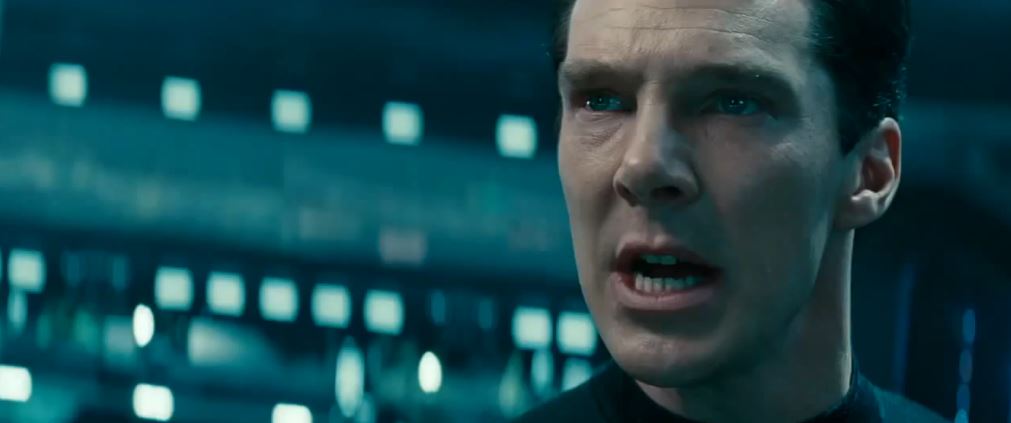
When a series of direct terrorist attacks jangle the nerves of the Federation's Starfleet on Earth, a now estranged from command, James T. Kirk(Chris Pine) finds himself torn between his role as the Enterprise's still green (often reckless) leader, and an emotionally compromised avenger. With the core suspect behind the attacks, the once-considered high ranking officer, John Harrison(Benedict Cumberbatch) on the run, it is up to the newly re-assembled crew of the U.S.S. Enterprise to either render the criminal turncoat dead or alive. Meanwhile, Spock(Zachary Quinto), Uhura(Zoe Saldana), Scotty (Simon Pegg), and the rest struggle to grapple with the now volatile captain as aims are blurred, and stakes are dire in JJ Abrams' massive follow-up to the 2009 re-envisioning of the Gene Roddenberry classic. A sequel that ends as breathlessly as it opens, by doing as much nodding to Treks of the past, whilst adding all the sound and fury expected out of a lumbering summer entry.
When we last saw our favorite crew, the fatherlike Captain Pike(Bruce Greenwood) granted the upstart Kirk with the keys to the newly minted Enterprise and her crew, with a hopeful smile and romance for the unpredictable. But what was shone so bright not so long ago has shown its luster, and now sees the often foolhardy young captain at odds with those who saw so much promise. Kirk has yet to fully understand the temerity of leadership, and seems more likely than ever capable of leading his crewmates into certain doom. And no sooner that this comes to a head than when things are shattered so far, leading him on a path at odds with virtually his entire crew (who often have enough of their own things to contend with-IE Spock/Uhura difficulties) as he finds himself at the head of a massive Starfleet manhunt for a man with apparently deep knowledge of secret activities, and apparently a battery of combat ability the likes noone has ever seen. And once again, the heart versus the mind core of the series; the central relationship between Kirk and Spock is taken to new limits as rules are questioned, and feelings of loss are examined. Feelings that could be a harbinger of difficulties yet to come. The Enterprise's darkest hour may very well be at hand.
While one can just explain away the remainder of the film's plot, it would be detrimental to go any further as the entire aim of the film shifts after what feels like a pretty solid two thirds. Early on, Kirk's arc is well-established as he finally must contend with his own worst qualities, and is placed in a fog that could just as easily bench him as allow him to rise into the captain we know and love- with his entire crew in the balance. So when the philosophies of the characters work wonders in many sections throughout the film, there lies the secret to the success of the often clumsily-plotted, yet likeable first outing. Whether they run afoul of a young planet's primitive inhabitants in lieu of the Prime Directive, or find themselves in the belly of the Klingon beast, the chemistry across the board of palpable. Even as the action reaches absurd levels of wannabe Star Wars/Indiana Jones, it's the cast that makes so much of it delectable. Most importantly a more nuanced series of performances by Pine and Quinto, who very much make these legendary characters their very own, with cadences that have their own fun and effectiveness. New to the tale, aside from the mysterious villain, are the additions of Admiral Marcus (played by Peter Weller), and Science Officer Wallace(Alice Eve) who both offer up thinly veiled wrinkles of possibility. And then there's Cumberbatch's occasionally frightening Harrison, a man so single-minded in his aims and yet so shady in his motives, that it is rather unexpected when we find him to be almost sympathetic and exciting to watch as a broken soul in a lean truck of a form that's intimidating to put it lightly.
And now we come to the part of the review where the film really swerved left when it should have rode the shoulder. There have been a number of instances where I have found myself at odds with what the internet has dubbed "spoiler culture", an overall avoidance of early news often perpetrated by the movie geek blogosphere and beyond where early information is leaked to the chagrin of the production staff, often done for little more than site bragging rights. And while I myself can see why some would rather go into a film cold, it is dispiriting to see films derail themselves in hopes of proving the wonks of the internet wrong, if only for a few moments. Which is where Into Darkness hits a bit of a wall come the pinball-ricochet finale. It's a move so overt, so informed by fandom, that it in many ways robs the entire new series of its initial potential. Even when the plot of 2009's Trek carried with it many unsolved contradictions, puzzling behaviors, and so on, it often found itself buoyed by the characters. And this time around the bulk of the problem comes at a most crucial section, and finds the remainder of the film unable to regather the same stability. There is actually no reason for the choices made here, and become more baffling with each moment I write this. Especially when the most reasonable explanation for said decision can only be in hopes of both derailing and kissing up to a contingent that the previous film seemed only peripherally interested in, the old guard fans. It's a move that proves to be less clever than it so pretends to be, and lacks the kind of freewheeling sense of fun that had been promised by the first half. Outside of a majority of the LOST television series, rarely have I felt so bothered by this creative team's fallback posture of relying so heavily on familiarity to save what could have easily worked out more organically. This lack of faith in the setup, leads the new film into places that while remain boundlessly amusing, feel more than a little empty.
So with all of this said, there is quite a bit to admire about Star Trek Into Darkness as the now-familiar "dark middle chapter" film of an already well-established new franchise. It delivers the melodrama and spectacle where needed, and the cast is more than up to task this time.(Not to mention, Michael Giacchino's score that outflexes the original in pure emotive power) It's just far too bad that faith seemed to find itself lacking where it needed it most. When will we learn that it isn't spoilers are the problem, but rather the attitude inherent in the delivery? There are sincerely moments here I wish to keep with my lifetime of Trek memories, but it's going to be hard to overlook a final act that insists on the franchise's most beloved film for prestige. Even new fans deserve much better.
Saturday, May 11, 2013
Andromedia(1998) Movie Thoughts
Beyond belief that it has indeed been fifteen years since Japan's V-cinema madman Takashi Miike left the confines of low-budget gangster/violence productions for the commercial big time. And strangest of all, it's all the more jarring that it was a music superstar fantasy vehicle that made this transition come to life. Much in the vein of The Beatles, The Who, and so many others, an attempt to make teen idol quartet, SPEED into movie stars must have seemed like a natural boon to the folks at TBS, and their record label while the Spice Girls made their baffling shot across the bow on the other side of the planet. So sad then, when the Miike-helmed ANDROMEDIA lacks any of the energy (read: attention by way of obnoxiousness), or even enthusiasm of said short-lived marketing juggernaut. What we have here is a J-pop film so devoid of core, so bereft of inspirational spark, it might just as well be a photocopied local concert leaflet stuck in a grating. A children's cybernetic fantasy as told by a manic depressant, what culminates in this mainstream debut is perhaps more telling than its ineptitude may imply.
Hiroko Shimabukuro stars as Mai, an ordinary girl who's long unrequited childhood love comes to an end, mere moments before her life follows suit. Killed by an oncoming truck (or her own lack of cognitive awareness, or new boyfriend's unfortunate timing- whichever one prefers), Mai's memories and virtual consciousness is then inexplicably manifested in digital form by way of her computer science genius of a father (!??). Mai has now become the virtual entity known as AI (Get it? Hur-hur), and it's up to her friends, including Yoko, Rika & Nao (The remainder of SPEED- Eriko Imai, Takako Uehara, & Hitoe Arakaki), and her grieving new boyfriend to save her from the clutches of her father's employers. Why? We're never truly let in on this particular piece of narrative necessity. Then again, much like how we suddenly learn of the father's abilities(which include the means to compact nearly an entire lifetime of memory and personality into what seem to be no more than three DVD-Rs), much of ANDROMEDIA doesn't bother with the details, and just lumbers on it its concrete grey-infused jumble between chase movie, music video, and bizarre 1990s teen angst.
So many elements seem readily in place for the film, but without anything to hold them together, we are subject to nuggets of film ideas merely allowed to float freely without any binding thread, making for a frustrating & often painfully slow experience. It's easy to see where such confusion comes from within the initial five minutes as we are introduced to the central couple of Mai & Yuu, a pair that almost implies a completely different manner of movie. The inciting incident also has the distinction of being one of the most flippantly executed (and in turn, unintentionally hilarious) ever committed to film. So when we are expected to understand the hows and whys of Mai's becoming a computer-generated entity, we are barely given anything of worth to hold onto. Making matters even more headache inducing, is that the plot to not only destroy the program's creator, but to acquire AI for themselves is never fully addressed in any satisfying fashion. In fact, it is very much neglected openly, as if we should fully be aware that none of this carries any weight of any kind as long as we shut up, and get to enjoy SPEED - Terrific. Suddenly disappointed that I wasn't having certain vagrant chems suggested to me.
So as described already, ANDROMEDIA is a difficult thing to take in as this grand transition between the days of gangland insanity like Dead Or Alive, and colorful adaptations such as Yatterman & Ace Attorney. To even attempt to do this work any justice is to invite arachnids of insanity in, and allow them to gnaw away at the brain centers that keep depression in check. Once it is made clear that AI has taken on the traits and appearance of Mai, but is confined to an oh-so-dated junky looking laptop, the movie then finds itself unable to decide whether it is a family-friendly FX-laden fantasy, or dark and melodramatic teen soap. And this is something that pretty much makes up the bulk of the film, (no joke, the movie just loves stopping mid-action to pour on gallons of unearned despair) until it shifts again due to the truly bizarre appearance of SPEED's boy-band equivalent, DA PUMP.
...
That's right. Let that one sink in..
Where a chase sequence ends in the destruction of a car, leading to a music video involving an abandoned garage surrounded by sheet metal & FIRE.
Why they have decided that there is no reason to fear that the bad guys wouldn't barge into this, and proceed to end all of this in a senseless hail of bullets still kind of baffles me. The fact that Miike never flexes such a daffy move remains disappointing, and this trend continues on for a majority of the remaining running time.
And that's pretty much what sums up my ultimate feelings on ANDROMEDIA - It's a ransacked back alley behind a Tower Records that has broken pieces of ad copy that offer up something potentially interesting, but sees no means of making it work as there remains no rhyme or reason for it being so messy. It's not even chaotic enough to be interesting, it just lumbers along as if being held back by obligation rather than enthusiasm. ("I guess I'll just be a movie..") It's this neglected middle child who is well aware of its position in the sibling chain, and just lies back, listless and unwilling to offer more than a halfhearted wave, while wearing a sarcastic T-shirt. If there's anything worse than an uninspired production, it's an uninspired production by a director who is often known for moments of sheer, biting inspiration.
Which leads me to looking back at all of Miike's output (that I have seen anyway - the man is the very definition of prolific), and considering all the bad that comes with the good. As excited as many of us where about his potential during those heady latter 1990s-early 2000s, his strengths as a filmmaker were often in shocking violence, and awkwardly surreal humor. So when one asks him to step well outside this milieu, it shouldn't be too much of a stretch to feel like this wasn't the best fit for his abilities. Now what could have at least happened here was something truly out there. And the biggest problem dogging this film, is that despite some TRULY bizarre stuff injected into strangely carved out corners of the story (mostly within a subplot involving Mai's angst-ridden, long-lost, cancer-stricken half-brother, played by Yukinari Tamaki), there is little energy holding any of it together, almost as if the director was aware that this wasn't enough to work with, and had zero assistance along the way. And again, looking back at when Miike's energies are not feeling the spark, films that could have easily found their way conceptually, often fall flat - Something that epitomizes what happens here. It's all a mishmash of intentional and unintentional weird, and it simply isn't enough.
Oh. And do I go ahead and make mention of the inclusion of some wonky guest casting choices made for this most auspicious mainstream debut? A large part of the film's truly mental nature comes courtesy of none other than legendary cinematographer/part-time actor, Christopher Doyle, who's role here of main heavy is only made worse by way of a computer translator conceit in the film that speaks over his english dialogue - with NO subtitles to allow clarity of anything he is saying. His jarring role notwithstanding, turns by TETSUO's Tomorowo Taguchi, and the ever reliable Naoto Takenaka further take this film down a rabbit hole only the hardcore shut-in may be interested in. Do any of them seem to know what kind of movie they were making? Doubt that they cared(except maybe Takenaka), and it shows.
So this is what can happen when the attraction of bigger budgets and higher profiles comes a-knocking. We could get something borderline inscrutable. Wait. Scratch that. ANDROMEDIA is an inscrutable and often stupefying experience in commercial vacuousness that feels more like a funeral than any Lars Von Trier work, and akin to a directorial Freudian slip. It knows it is headed for dim and darker days, and wants us to follow along. Miike might very well had seen the end of the world, and it was buried deep within a dumpster filled with AKB48 CDs..
Saturday, April 27, 2013
The Thieves (2012) Movie Review
Sometimes genre isn't merely a checklist of concepts tasked with reaching out to larger audiences, and is akin to a language that multiple diverse cultures must meet halfway upon in the name of a globalized populist cinema. In the last ten years alone, we have seen other countries rise to the challenge that Hollywood had long claimed domain, to occasionally classic-making results. So when we consider Dong-hoon Choi 's grand paean to the international heist comedy, it might come to no surprise that South Korea might very well be one of the last great bastions of movie scale outside of tentpole filmmaking. When a two mildly dysfunctional teams of professional thieves collaborate on a casino job for a one-of-a-kind diamond, matters are intensified by old flames, delicate bonds, and an ever complicated security arena. The Korean team, led by the younger and foolhardy Popie(Lee Jung-Jae), eager to prove themselves beyond mid-scale capers, and team Hong Kong, run by the smooth-natured, Chen (played to charismatic highs by HK favorite, Simon Yam), who's group contains its own idiosyncratic breaks in the armor seek a prized connection and mentor, whilst courting unprecedented danger levels with the addition of master thief. And while this simple premise is on the whole terribly familiar, much like the characters within the story, the secret to Thieves' blazing success lies in understanding the framework, technical chutzpah, and terrific ensemble.
Starting within an awkward comic setup involving a secretive art dealer's stash ( a con which will come heavily into play later), Popie and his crew show a quick flare for improvisation, but perhaps a tragic lack of grace. Popie's team consists of elder linguist and veteran, Chewingum(Kim Hae-Suk), ambitious cat burglar, Yenicall (Jeon Ji-hyun), and cable assistant, Zampano (Kim Soo-Hyun) who find themselves capable, but have garnered something of a dangerous trail. Revealing something of a lack of foresight on the part of this weird cadre of career criminals, Popie receives a call from once penniless, but now legendary heister, Macao Park(Yun-seok Kim) in hopes of guaranteed success. And with good timing as the authorities are practically knocking on Popie's door. So when the central hit involves a frightfully secure casino, and a plan to steal a jewel, only to sell it back to its owner - a notorious gangster, it really becomes a nasty rock & hard place scenario. So when Park also realizes that Popie has also tapped the newly released from parole Pepsee (Kim Hye-Soo), things are made even more unstable.
And the less we go into Chen's group, which includes only somewhat dependable talent such as Andrew(Oh Dai-su) , Johnny(Kwok Cheung Tsang), and a safe cracking legacy in Julie(Angelica Lee of The Eye fame), perhaps the better.
Right away, Choi's propensity for kinetics & humor confidently introduce us into the world, and makes no bones about this being little more than stylized fun. While stakes do in fact reveal themselves to be very real, a lot of it is done in a frenetic, decompression-happy manner where crap does in fact "get real", but is almost responded to with a sly gag or cool-headed display of sardonicism. Really more of a jazzed-up remix of his earlier hits, The Big Swindle, and Tazza: The High Rollers, Thieves is also quite eager to please in its attempts to match/surpass much of what has come before in the subgenre. The bulk of the film finds itself rather comfortable weaving and whisking in between the varied, and often dysfunctional characters, often revealing some satisfying dollops of complexity, even as the action ramps up to Mission Impossible levels at times.
Another exciting angle worth mentioning, it's the openness to a more globalized world that also makes Thieves stand out. With characters flippantly jostling between asian languages, the whole affair feels very much like how one would imagine an intricate spy or even futuristic science fiction novel. The diversity on display is not only inspiring but energizing for a glossy piece of escapist silliness. There's clearly a lot of effort being made on set to make this more than an Oceans knockoff, in fact, it seems far more involved than that series ever dared itself to be. It's perfectly comfortable in a contemporary world, and such a focus is kind of rare even now.
Also worthy of major note, is the cinematography by Yeong-hwan Choi which takes impressive advantage of location shooting in Busan, Seoul, Macau & Hong Kong, which is often gorgeous, and evocative of the best caper films of the past. At times it feels more than ready to take on the Bond franchise, and could probably do with with simple ease.
Now where the film perhaps suffers a bit, it's perhaps in our lack of central emotional compass. It's no spoiler to declare much of the cast to be morally muddy, and that some of the more likeable characters do not see the final reel. But as this is a kind of almost classic Lupin III world that is bring portrayed here, it stands to reason that we are in a den of would-be anti-heroes, not necessarily working in the interest of the group. And yet somehow, Choi figures out ways to make us feel more than mere resentment for being around such a den of squabbling vipers for nearly two hours. In fact, there are moments interspersed within the action that are capable of leaving one perhaps even a little charmed. In classic caper fashion, there is always someone far worse watching from within plain sight, and it is here that the movie dares us to play the bad guy for a spell. He is having an opulent party at our moral expense, and it doesn't feel like a terribly steep price to pay.
Tuesday, April 9, 2013
Thematic Wanderings: Shozo Hirono & The Yakuza Politiq
Been spending so many months considering how film is often a forum for not only the requisite escapes and flights of fancy so many viewers come to expect from a night at the cinema, but also of challenging, and often regressive forms of political musing. Much in the way that classic art and literature, at their core presented interesting ways to serve the public without being harshly transparent. And while many works attempt to avoid this, it is undeniable that many of filmdom's most iconic works are in fact collage-like representations of social constructs, questions, and occasional rally cries based on daily life of the time in which it was filmed. Even as markets lean more and more toward remakes and adaptations, it is not without an often pointed concern that even more spectacle-centric features are capable of carrying with them very real questions about the role of citizens versus that of those running the show. And the further we look back, the more this is evidently obvious in societies young in this manner of film discourse.
Specifically in realms of more rough and ready forms of media of the late 1960s-early 1970s anime and Japanese film, there was so much happening outside local movie houses and homes, that it was hard to watch anything of impact without it alluding to some form of strife taking place throughout multiple sectors of the post-war era. Where in anime, much of this frustration and angst could be seen manifested in works such as Devilman & others, few filmmakers captured the full-frontal conflict of hidden societies, scraping desperately for ever-shrinking dividends than Kinji Fukasaku. A man who's Battles Without Honor and Humanity (aka - The Yakuza Papers) series furiously carved out a stifling vision of systems forged and unforged in real time, without what so many once imagined to be firmly established codes. In this series, centering on the twenty-plus year war over Hiroshima's gangland titans and small fries, each installment paints a bloody tapestry, loosely based on real events that rocked an already unstable nation weary from conflicts abroad, aching for some manner of new identity.
With the young and often idealistic Shozo Hirono (in an icon-making performance by Bunta Sagawara) struggling to maintain a sense of honor to an increasingly chaotic underworld, we are host to a full-tilt typhoon of violence, treachery, and tattered pride that was up until that time, unseen in Japanese crime dramas outside of some of Fukasaku's earlier excursions into post-war criminality. Where Street Mobster, and others flirted with the dregs of an economic rollercoaster, the Battles saga dives headlong into the beast's belly, often surrounded by antiheroes with varying degrees of trustworthiness. Most of which is displayed by Sugawara's Hirono, a weathered man who's struggles from the very bottom of the pecking order, take him to the highest levels in Hiroshima gangland. His central struggle being that a man of old fashioned codes and morals, almost constantly finding himself in danger of irrevocably being stained by the erosion, not to mention treachery coming at him from nearly all sides.
Perhaps this is best encapsulated by his almost bleakly humorous relationship with would-be kingpin, Yamamori (Nobuo Kaneko), perhaps the new face of Japanese leadership. Sniveling, petty, and cowardly to a tee, Yamamori's almost whiny money-man approach seems primed to infect generations of more "jingi"-based members of the local families. This almost absurd invasion of big business into the affairs of those who would rather see themselves as local "Robin hood" types soon reveals hidden motivations, and newfound lusts for power that find Hirono almost inescapably trapped in Yamamori's orbit. Even as he begins making a name for himself amongst the Kure City gumi, the old man is never terribly far away. Almost becoming the father he never wanted, Yamamori (and even his equally cartoonish wife) ingratiates himself into poor Hirono's life, often leading to some truly terrible conflicts and bloodshed. The absurdity simply being in that our hero's often hard wood stubbornness to be the more honorable man keep him from destroying this longtime rival once and for all. But alas, nothing is ever so simple, therefore the two often require each other despite such animosity.
By the time we get to Proxy War, this is made into greater manifest once Hiroshima's gangs are met with a most unlikely leader in Uchimoto, "successor" to the Muraoka clan. Whiny, petulant and cowardly, he is in many ways a far more irresponsible rendition of Yamamori, only with that much more reckless pride. Even as Fukasaku front-loads the "messages" behind this third film, the story is no less potent in its satire as a multitude of the town's most brawny gangsters find themselves at the whims of a pair of niggling manchildren, ready to spill blood over the most shallow of justifications. In many ways a mirror to the tumult happening in the streets of Tokyo(Not to mention the world abroad) , with those in power squabbling over scraps as the young and powerful are meant to fight amongst each other (and often die) for what Fukasaku likely considered to be patently absurd reasons.
What makes the Battles series so singularly political, is evident from Fukasaku's unflinching rage that is painted with grand strokes and striking sound, often making no bones about the horrors that lie under the veils of propriety and tradition that are bandied over others in the name of order. Rituals of bonding and unification suddenly take on a mechanical, often transparently disingenuous nature, and are little more than showcases for which new schism is soon to appear, ready to unravel virtually seconds later. The worms of pride, and greed underlie virtually every "diplomatic" move that is made, often a false formality, and far from interested in anything as noble as peace. In the world of Fukasaku's yakuza, power is fleeting, honor is questionable, and even the strongest find themselves at odds with comrades, even to the point that they must grovel at the feet of their greatest rival for some infinitesimal piece of rotted meat on petrified bones.
Thursday, April 4, 2013
Special Rumbles: Lessons From Roger Ebert (1942-2013)
Despite yesterday's news regarding his health, there was no part of me that was in any way prepared for writing up several thoughts regarding the importance of one Roger Ebert in my social, and written life. To be completely fair, noone is truly prepared for such a thing. But to give a complete charting of just how important one person's views can be toward so many angles of another's life, it is also something possibly foolhardy to consider. But what I can best deliver in a timely, and hopefully raw fashion, is to keep beacons glowing in the name of what makes criticism so important to not merely film, but to human culture as a whole. Much like how achaeologists derive theory from findings and disparate elements available, there is a deep importance toward our collective ability to see beyond mere positives and negatives. To dole out how something makes us feel, rather than merely take in everything at face value wthout second thought, or future evaluation. And there were fewer voices available to so many of us in the broadcast age with such a reverence for the unusual, and the accessible than Ebert, a man who's very presence on television or in print, exuded a yearning to understand not only an evolving artform, but a rapidly morphing world.
Growing up a remarkably addicted child of movies, Ebert's views on At The Movies remained an integral part of my weekend viewing diet. To be in my presence throughout a majority of the late 1980s meant that this ritual was an expected norm. And it wasn't merely because of access to clips of the latest releases, and whether or not they received a thumbs up or down, but rather my focus was largely on how both Gene Siskel & Ebert went from gentle confirmation to outright verbal blitzkrieg in mere minutes, and still retain a fair amount of sympatico by the end of each episode. And despite the often whispered revelation that the duo in fact didn't get along well outside the theater for a time, it was endlessly exciting to see such worldviews interconnect with such energy from their reaction to something as commonly seen as diversion as film. They spoke a mature form of a language I long wanted to be able to grasp, even as I grappled with the often humiliating trial known as grade school.
Moreso than any other televised movie critic, there was an inherent relatability to the way Ebert examined movies that told me, "I could do that". In fact, I vividly remember recording my first movie review "podcast" with my best friend by way of cassette tape, capturing our reviews of movies like Robocop & Rocky IV. This went even further come the early 1990s, when a good high school friend of mine fand I wrote a "He Said, She Said" column for our local newspaper's experimental "youth" section. Sharing impressions was a major part of what drove me to write, and perhaps it seemed inevitable that japanese cartoons would eventually follow. It wasn't enough for me to merely watch something and forget about it in preparation for the next life trial, it was vital that I take it down somewhere, or talk it out with a fellow weirdo. Discourse was on the brain from a very early point, and Ebert was unquestionably a large part of why.
And as I mentioned, growing up the only kid in a nearly 40-mile radius who was halfway interested in cartoons from across the ocean, as well as weird movies from other parts of the world, it was great to have someone on TV with the openness & enthusiasm he did. Whether it be his surprising segment on AKIRA, or opening up about Miyazaki's works, it was strengthening to see someone in the grand sphere talking about something so many were so quick to write off in those days. In fact when they happened (which was not at all often), it was this brief moment of relief that came over me. A reminder that I had indeed run into something that spoke to far more than a small niche of strange kids/adults, and that it was something worthy of merit on a world's stage. A confirmation that art could be found just about anywhere as long as one is taking that extra moment to look.
Among the more important lessons I took away from him being such a presence in my life, was that articulation was vital toward greater connection between very different types. That it wasn't enough to merely say your piece, and abandon room for further discussion. Walls were malleable and filled with gaps and curves which can shift and bend based on shared experience. That the wheel must continue to turn in the name of a healthier ecosystem. And while differences are an inevitability, they are also what make us so valuable to others. Enthusiasm for art, idea & expression flowed naturally through him, and it was infectious, especially when meeting new people who shared a similar affinity for the language.
And to be even more on the even side, it wasn't as if I agreed with his views all the time. In fact, a there were multiple instances where I simply didn't understand where he was coming from with many films that have since become important in the eyes of the public. For instance, I have never, and likely will never understand his evisceration of Blue Velvet (1986). But perhaps therein lies the greatest lesson; that critique of any kind is less about the object being reviewed, and often more about the person doing the review, and the others they are reaching out to. It's continued communication in celebration of something shared, also made by human hands. There is something inherently natural about reacting to the world, and examining the results on an individualistic basis. Just as no two people will see the same sunset in the same way, there is something important about the ability to take a human work, and derive a nebula of thought.It is within this important activity that our futures are founded, and universes are rendered endless.
But another really important thing I learned by way of watching and reading him, was that I didn't have to agree with a person's assessments, and maintain respect. That it was indeed possible to trade barbed differences upon anything, and still seek to understand the other person, which should be one of our greater goals as a species. Ebert saw human civilization as a triumph, and there is no triumph without regard to the past, and at its most primal -- that is the cinema's greatest gift to all of us.
That is what I'd like to believe anyway.
Growing up a remarkably addicted child of movies, Ebert's views on At The Movies remained an integral part of my weekend viewing diet. To be in my presence throughout a majority of the late 1980s meant that this ritual was an expected norm. And it wasn't merely because of access to clips of the latest releases, and whether or not they received a thumbs up or down, but rather my focus was largely on how both Gene Siskel & Ebert went from gentle confirmation to outright verbal blitzkrieg in mere minutes, and still retain a fair amount of sympatico by the end of each episode. And despite the often whispered revelation that the duo in fact didn't get along well outside the theater for a time, it was endlessly exciting to see such worldviews interconnect with such energy from their reaction to something as commonly seen as diversion as film. They spoke a mature form of a language I long wanted to be able to grasp, even as I grappled with the often humiliating trial known as grade school.
Moreso than any other televised movie critic, there was an inherent relatability to the way Ebert examined movies that told me, "I could do that". In fact, I vividly remember recording my first movie review "podcast" with my best friend by way of cassette tape, capturing our reviews of movies like Robocop & Rocky IV. This went even further come the early 1990s, when a good high school friend of mine fand I wrote a "He Said, She Said" column for our local newspaper's experimental "youth" section. Sharing impressions was a major part of what drove me to write, and perhaps it seemed inevitable that japanese cartoons would eventually follow. It wasn't enough for me to merely watch something and forget about it in preparation for the next life trial, it was vital that I take it down somewhere, or talk it out with a fellow weirdo. Discourse was on the brain from a very early point, and Ebert was unquestionably a large part of why.
And as I mentioned, growing up the only kid in a nearly 40-mile radius who was halfway interested in cartoons from across the ocean, as well as weird movies from other parts of the world, it was great to have someone on TV with the openness & enthusiasm he did. Whether it be his surprising segment on AKIRA, or opening up about Miyazaki's works, it was strengthening to see someone in the grand sphere talking about something so many were so quick to write off in those days. In fact when they happened (which was not at all often), it was this brief moment of relief that came over me. A reminder that I had indeed run into something that spoke to far more than a small niche of strange kids/adults, and that it was something worthy of merit on a world's stage. A confirmation that art could be found just about anywhere as long as one is taking that extra moment to look.
Among the more important lessons I took away from him being such a presence in my life, was that articulation was vital toward greater connection between very different types. That it wasn't enough to merely say your piece, and abandon room for further discussion. Walls were malleable and filled with gaps and curves which can shift and bend based on shared experience. That the wheel must continue to turn in the name of a healthier ecosystem. And while differences are an inevitability, they are also what make us so valuable to others. Enthusiasm for art, idea & expression flowed naturally through him, and it was infectious, especially when meeting new people who shared a similar affinity for the language.
And to be even more on the even side, it wasn't as if I agreed with his views all the time. In fact, a there were multiple instances where I simply didn't understand where he was coming from with many films that have since become important in the eyes of the public. For instance, I have never, and likely will never understand his evisceration of Blue Velvet (1986). But perhaps therein lies the greatest lesson; that critique of any kind is less about the object being reviewed, and often more about the person doing the review, and the others they are reaching out to. It's continued communication in celebration of something shared, also made by human hands. There is something inherently natural about reacting to the world, and examining the results on an individualistic basis. Just as no two people will see the same sunset in the same way, there is something important about the ability to take a human work, and derive a nebula of thought.It is within this important activity that our futures are founded, and universes are rendered endless.
But another really important thing I learned by way of watching and reading him, was that I didn't have to agree with a person's assessments, and maintain respect. That it was indeed possible to trade barbed differences upon anything, and still seek to understand the other person, which should be one of our greater goals as a species. Ebert saw human civilization as a triumph, and there is no triumph without regard to the past, and at its most primal -- that is the cinema's greatest gift to all of us.
That is what I'd like to believe anyway.
Subscribe to:
Posts (Atom)