Showing posts with label PIXAR. Show all posts

Sunday, November 4, 2012

Wreck-It Ralph: Immigration, Eminent Domain & True Democracy


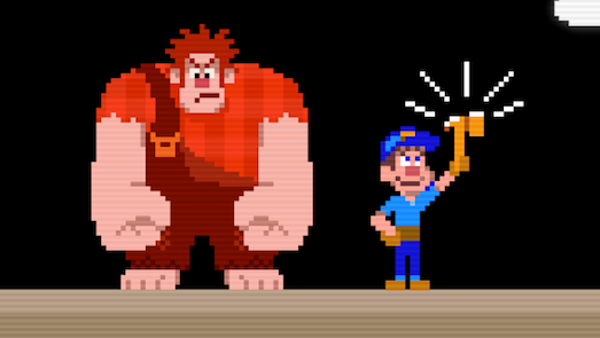
Kind of funny to consider that the last time I went on about a Disney-produced film taking on prescient socio-political issues by way of childhood playthings, it was at the hands of animation stalwarts, PIXAR whose films have continued to break box office records, conventions, and deliver on multiple fronts. And to add this to how 2012 has played itself out, it's also amusing to see these guys, and the more traditional Disney studios seemingly switch roles as Brave seemed more comfortable in continuing the ever changing Princess narrative. So in comes 's irresistibly charming Wreck-It Ralph, a film that not only makes a near-perfect play for this generation's Toy Story, but also carries within it, a bold set of statements regarding a changing, more aware American narrative. This couldn't be more clear from the opening scenes in which we learn of our title "bad guy", and the circumstances surrounding nearly thirty years of living in the shadow of video game hero, Fix-It Felix.

As the voice of John C. Reilly's Ralph, his hulking brute physique, and tendency toward violence toward the buildings within the game world he lives in is based on the limited programming of the era, but it wasn't without reason. The narration and flashbacks establish immediately that before Felix and the clean-cut, seemingly well-to-do citizenry of this world came about, Ralph was living on the land where this building now stands. Bullied off, and doomed to live in a literal dump, and understandably upset Ralph then took it upon himself to rebel, thereby wrecking this structure on a regular basis. And this ensuing battle between the estranged Ralph, and the ever persistent "fixing" of Felix, to the rejoicing of the diminutive citizenry continued on for decades, leading to an upcoming 30th anniversary of the game's existence. No small feat for a game largely surrounded by newer, flashier machines. ( A point which we'll get back to shortly)

So when the time comes, and Ralph wishes to be at the very least acknowledged for his role in the game's history, he is practically ignored at an anniversary party--even as Felix himself basks in the limelight, he too cannot help but hope Ralph remains in his "predestined" place. Cake metaphor goes even further to display his own tiny shred of hope that what he does serves a greater purpose. The game's mayor, and party attendees seem content in knowing that he live forever as an outsider, even as they neglect that without him, there is no game. So when Ralph takes it upon himself to break protocol, and escape the confines of his machine in hopes of seeking another way of attaining adulation and respect amongst the elite,  it shouldn't be too much of a stretch to begin putting the pieces together as his first attempt toward his goal, is to enter a hyper-violent first person shooter in the hopes of winning a medal. Proof that he himself is capable of respect in his home, he attempts to brave the horrors of realistic combat in a futuristic alien environment. Which is where he acquaints himself with Sergeant Tamora Jean Calhoun, a rough and ready soldier, a hardened warrior with a hidden past. Mere moments in, Ralph finds himself beyond over his head, but still figuring a shortcut toward his goal.

It isn't long after this, when Ralph finds himself within the colorful realm of the chibi-racer Sugar Rush, where he meets his match in Vanellope von Schweetz, a perky underdog with the distinction of being dubbed a "glitch". (an outsider feared for what she could mean to the game as a whole) Within the kingdom of Sugar Rush, the local monarch in the form of King Candy is seen as a befuddled, happy old chap with a seemingly benevolent nature, save for his concern over Vanellope, who is seen as something that could mean certain doom for a game's existence in the arcade. Sequestered to an unknown section of the game, Vanellope intends to race no matter what which perfectly mirrors the dilemma of Ralph, making them perfectly unlikely foils to a seemingly rigged pyramid.

This is made all the more explicit after Ralph's disappearance from his game renders his once-dismissive compatriots useless, forcing the game to be deemed "out of order".--[IE- Irrelevant]

So what does this all add up to in the end? I don't find it out of the realm of possibility that Wreck-It Ralph joins Cloud Atlas in this season's stories regarding the changing face of class, and the ever-present reality of eminent domain, meaning the role of a society's unseen, often those native to developing nations who are often politicized in a negative light in hopes of maintaining a currently popular reality. Ralph and Vanellope, natives to their respective worlds, find themselves displaced, and often ignored by those in power. Both eager to prove their mettle and value to the group, their mutual arcs reflect an idle worship of a system they themselves have surrendered to. Ralph moreso than Vanellope, who stands proudly alongside many of her own imperfections. So when he finds himself in his greatest inner conflict, it is within the faith of another with similar problems does Ralph find redemption beyond what the current paradigm could possibly reward. While so many in the worlds of these games adhere to an invisible order that resembles a top-down monarchy, it is Ralph and Vanellope's divergence that offers up a more realistic vision of the societies they inhabit.

So when we look at the clean-cut, blue eyed representation of infrastructure in Fix-It Felix, we are given a peek into privilege at a loss to understand a larger world view. His story, while endlessly perky, and helpful, is only so, like Ralph, due to his programmed fate. He is merely following protocol without question, to the adulation of the mayor, and clearly rich citizenry. Never considering that without Ralph, he is essentially useless. And as a bonus, his schoolboy yen for Calhoun is particularly suspect when considering the American narrative in regards to the privileged throughout history. Tying this back to Ralph's frightening tour within Hero's Duty, and the immigration ( and perhaps even the gentrification of so-called "lower" classes) issue, everything makes pointed, brutal sense.

When one considers the wacky, pixel-heavy world of Wreck-It Ralph, one may be able to see past the gloss to find themselves thinking a little more about where we as a nation are today, and perhaps once and for all consider how we all arrived at this point. And hopefully, those who do may consider a greater narrative that is perhaps more human than any play at generational familiarity a movie can be.  

Tuesday, June 22, 2010

Axioms Of Change (More thoughts on Toy Story 3)


Do we even need addressing here? I suppose it might be, in order to have a record of my feelings on the ideas shared on the film while they're still fresh. But it seemed pretty clear to me that PIXAR was not only going for broke with their grand finale, but also looking to better illuminate a world that has only recently opened up toward lifestyles & solutions long ignored by the mainstream. And much like a humble parent, Unkrich, Doctor, Lassiter, and the rest of the Toy Story crew have taken great pains to spotlight a changing planet gleaming with the kind of possibilities a child has with their imagination.

- The Sunnyside Day Care tale is one of division brought about by an individual convinced of the inevitable pain brought forth by allowing unconditional emotions to reside. His solutions make sense to a population unsure of their place in the world as confused victims of whatever circumstance left them donated to the day care center. And in the hands of this leader, the aptly named Butterfly & Caterpillar rooms are an interesting play on words for divided states of maturation. A sort of, pre-emptive lifestyle designed to shield certain people from what can be considered "public service". Something a certain number of folks do not see as an enviable position.

- Ken. It's written in strokes the width of a superhighway. Despite the relationship between he and Barbie, it is clear that he is among the more misunderstood citizens of Sunnyside. And even as he had for a time attained a certain level of power before Andy's toys came, he was obviously in a relegated position with noone to really grasp what he was truly about. Much of this begins to change as the recently dejected blonde happily accepts him as a part of a "complete set". Being that they are toys, it is in the clothes-loving that things take a pretty obvious metaphor, and are upgraded by a sense of playfully adult humor without beating his thematic change into our minds. It's a sweet little subplot that ends pitch-beautifully by making him a new leader. Someone who grasps the hopes and dreams of the whole, as opposed to the fearful few.

- To a lesser degree, but no less amusing, Buzz Lightyear's Demo Mode mishap. By leaving the ever-dashing rocket man in Espanol mode, he takes on a romantic persona that comes off as a little superficial until one realizes, we're watching a big budget family film with aggressively fast subtitles. Something that could never have been considered ten years ago. A little something that only gets better as part of the Buzz/ Jessie subplot gathers steam throughout the whole film. And Jessie's growing approval of Mr. Lightyear via this technical goofup is a more than appropriate testament toward shifting cultural attitudes. It could also be argued that the switch on Buzz's back can be seen as a visual nod toward the splintering changes that are beginning to blossom in most unexpected places.

- Andy's decision in the finale & the inclusion of little Bonnie are also strong notions that change, while inevitable, do not have to remain bittersweet as long as there are new minds pouring new thoughts into the mix. After all, in the Toy Story universe, a toy's greatest joys are to be played with & to be there when a child needs them most. For Andy to keep Woody with him at college is fine and sweet. (It is indeed possible that the classic cowboy doll was a keepsake of his never seen father's) But in order for the toys to have a longevity of need, it is important that they remain in the service of the young. Hence the transition. As much as I love many of my old toys, it does pain me to merely leave them shelved. To see Woody and friends in the hands of such a spry, imaginative soul is not only evidence of the immortality of the inner child, but of all of us who long to retain the spirit of one.

Sunday, June 20, 2010

Some Thoughts Regarding Toy Story 3....

Toy Story 3 will make one believe that trilogies can make perfection.


And while I'm sure there'll be a few out there willing to make this curmudgeon eat a little crow for that slice of hyperbole, but I can't really find a more subtly accurate description for Lee Unkrich's fitting swan song to PIXAR's signature franchise. But more than that, it was a franchise borne from a most unlikely milestone. 1995's Toy Story was the now-legendary studio's claim to fame, and a more than brilliant means to tap an entire cross-section of generations by way of a most universal premise. To imagine a world populated by sentient toys and their lives unbeknownst to their owners is still by and large a stroke of conceptual genius brought to life by then PIXAR pioneer, John Lasseter. And having seen all of these films in their opening weekends, it is no secret that more than a PIXAR fan, I'm a huge Toy Story lover.

So seeing how TS3 ranks alongside its predecessors prior to seeing it, I must admit to being more than a little suspicious. Since Disney acquired PIXAR after years of relative independence, it was at a point when the studio's output began to waver a little for me. The thought that they had suddenly begun to go back on their promise of not being "in the sequel business" hurt a little of my respect. Wall-E & Up! Notwthstanding, there was something brewing within the ranks that made me concerned that the very announcement of a third Toy Story film was something to be feared. How does one even consider topping two terrific family films that helped break the mold for modern fare & introduced the world to the possibilities of fully digital cinema? After the thematic upgrade of the second film, it only felt natural that the world of Andy(John Morris)'s toys would continue on without another film. And adding ten years of film trend evolution, it almost seemed destined to be little more than one last cash grab before the new PIXAR is to become something a little less cavalier, and closer in tone to ever safe Dreamworks.

Thankfully, none of this has come to pass, and the film is a beautiful summation of not only the film series itself, but a bold allegory for a world changing. From the ashes of the "look at what we've wrought" darkness of Wall-E, Toy Story 3 handles both the sorrows and joys of letting go.

Transition is all over this film. 

From the central plot involving a now 17 year old Andy's transitioning into college, and the reaction of his childhood toys now negected in a sealed toy box, possibly awaiting a lifetime in the attic. (or worse, the landfill) What in many ways seems to be the skeleton of a typical Toy Story film is cleverly twisted into an exciting and at times emotionally punishing mediation on a world divided by the simplest of mistakes.

And that's all it is...a mistake.

The film also considers opening the canvas toward new colors of thought, doing away with even ideas that perhaps even the show's creators hadn't considered before. So that in the end, it feels as if the minds at PIXAR are looking to embrace ideas once foreign to them in hopes of inspiring themselves.

So even more than letting go...The film is embracing new worlds of possibility. 

Whether we are following Woody as he has been chosen to be the only toy to accompany Andy in his dorm, or Buzz, Jessie, Bullseye, The Potatoheads, Rex & Ham, as they have been donated to a deceptively inviting day care center, (With the attraction of children to play with too powerful to resist) the film stretches the original "lost-toys on a mission home" premise to its most logical conclusion.

When home is a person who is leaving, then where is home anyway? The invisible bond between us and those that granted us warmth in quiet times & great freedom of imagination is rekindled with an added dash of the bittersweet that comes with new chapters in life.

And yet it's the bonds that we have grown to have with these characters that help deliver some unexpectedly potent scenes mixed within the already proven action acumen. In Toy Story 3, the action is as great as ever, but it is the drama of the larger dramatic questions that give it it's juice.

Pitch-perfect performances all around from the original cast, including Tom Hanks, Tim Allen, Joan Cusack, Don Rickles, & even great turns by Ned Beatty, Michael Keaton, as well as a returning Wallace Shawn, John Ratzenberger, & Jodi Benson. Also an affecting as hell final score by series regular, Randy Newman takes fulll advantage of the wrap-up proceedings leading to a most impressive of curtain calls.

So many great moments that would be a waste to spoil for anyone. All I can use to best wrap this post up is to posit what it is that most impressed me aside from the already spectacular package brought on by Unkrich, Lassiter &  folks...

 I love that we see the ultimate expression of how division happens, usually at the hands of someone who while under most circumstances seems like a pretty on the level person, creating an environment of fear & neglect in order to stave off the hurt of abandonment. This has been hinted at before, most notably in 2, but never this clearly. What could easily pass for a tale for our current global situation in metamorphosis, the film followed a new PIXAR short titled Day & Night, which also beautifully illustrates the potential change we all have within. Change is never that far away, and if there is anything that can clock those changes best from our collective childhoods..it's the things that we have trouble imagining living without.

Toys included.