For all the ribbing I felt compelled to give JJ Abrams' latest, there certainly was enough ligament holding this adventure together, even as so much of it was tearing at the hinges toward the finale. Considering the more optimistic first outing which was reminiscent of the most forward thinking elements of the original television series, it was only natural that the second would be taking a more troubled path. Middling review aside, there was a small breadth of familiar subtext doled out throughout the film, again loudly ringing a decade where a society's technologically unbridled new horizons found itself compromised by fear & machination at the hands of an unscrupulous few. In a post- Dark Knight world, it's suddenly clear that commenting upon a nation losing course has been the chic text of choice for major blockbusters, and Into Darkness cannot see itself out of this particular thematic mire.
When we last visited the newly formed crew of the USS Enterprise, matters had reached a state of promising calm as newly dubbed Captain James Tiberius Kirk found himself what seems to be his predestined home. Starting off as a more volatile version of the ever cavalier lead, his arc centered largely on discovering his own sense of resolve, as well as the importance of his once great scholarly rival, and now unexpected comrade in Commander Spock. By way of living out this wholly new timeline created by a vengeful Romulan, much of Trek involves the cast in one manner or another finding their respective places upon the legendary starship by way of their already well-implanted character. It's so much less about science fiction than it is a treatise on not only familiar pop culture staples, but also of the post-Bush years, and the promise inherent in new leadership amidst sweeping change. As loud, brash, and often jumbled as the first film is, it's buoyed largely by a terrific new cast, and an infectious shot of enthusiasm.
As Into Darkness shotguns us into matters, we are given a Bond-esque sequence involving the Enterprise as they race to save a nascent planet from volcanic destruction. (the key problem being a need to do this whilst keeping within the parameters of the Prime Directive) It's a collossally fun, yet absurd opening which is meant to evoke some of the more loopy action episodes of the TV series- with that oh-so contemporary shot of adrenaline. With this cartoony take on the average Trek adventure at the front of the film, celebrating all that is colorful and fun about the world and characters, it isn't long before Kirk is punished for his resolution of the matter, and subsequently punished and stripped of his ranking. His one-time greatest support and quasi-father figure, Pike's patience is on one end running on empty with this often troublesome kid, and on the other, eager to grant him one more chance. These early scenes while standard for fare such as this, is also meant to remind us of a more romantic Starfleet that is soon to be in great jeopardy.
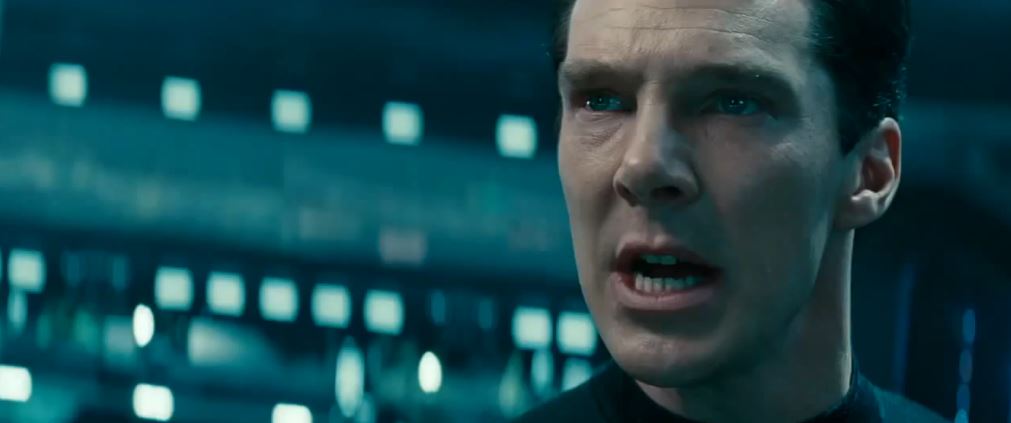
Our first run-in with this, is upon first catching up with Admiral Pike, and the fateful incident that sets the remainder of the film in motion. Unlike the original film's yen for colorful uniforms, we are introduced to a more militaristic array of grey upon all major players in Starfleet upon reaching Earth. Terror has hit too close to home, and matters of scientific advancement have yielded new, and increasingly complicated new dangers that have spurred on a need for Starfleet to take on a more defensive role. A shift in overall policy that runs counter to everything that the Federation (and our characters) have long stood for. With a number of high ranking officials (and innocent bystanders)killed by surprise attacks, Kirk is then pitted between his loyalty to his friends and the Starfleet way of peaceful exploration, and a need for settling the score against terror suspect, the deadly former Federation "agent" known as John Harrison. The once bright reds of the fresh faced newcomers to this space faring society have now given way to a more grim, hard gray that is made even clearer in a scene involving Kirk & Spock seeking permission from Admiral Marcus in order to pursue and take down the aforementioned criminal. Their uniforms in the scene denote a trim, closer to original uniform, albeit in dead tones, implicating a tainting of the original look, and therefore the thrust of their lives. In no way is this subtle, but it gets things across pretty viscerally.
And as the film progresses, and Kirk, despite regaining his command, seems at odds with nearly everyone on the bridge. As conditions after conditions come down from Starfleet high brass, Kirk seems more and more ready to accept some ethically questionable caveats to a mission that seems poised to be one of seek and destroy; something that couldn't be further from Starfleet's way. Having triangulated Harrison's location to the planet, Kronos, the heart of the now increasingly troublesome Klingon Empire, matters are worsened as Kirk is ordered to make a stand against this dangerous man without causing an interstellar incident in the process. Not to mention the ever more problematic addition of military grade torpedoes that have been brought about the Enterprise, under orders that they be the ones used against Harrison upon detection. Naturally, the reasons for this are not made clear, and Kirk is eventually placed at greater odds with all that he holds dear when he find himself relieving the ever-loyal and upright, Scotty of his duties for questioning these foggy orders. While some may consider this intensely un-Trek-like, this is precisely the point. It is this incident, and consequently the protests of Uhura, McCoy, and ultimately Spock, that make up the bulk of the film's thematic aim.
The remainder of the film tinkers with this debate as a society based upon diversity, pluralist cooporation, and nonviolent exploration is frightened toward taking a more martial posture. Kirk is ground zero again for a voyage of self discovery, this time being a test of how far he is willing to go for the well being of his ship and crew. His penchant for rewriting protcol, and diving in without looking has reached an impasse where he must consider the costs, and at the same time stick to his own principles regardless of word from above. Pike believed in that something larger than both of them surged deep within what Starfleet could be, and to witness the ferocity of Harrison's rage toward a Federation whom he feels wronged him, and an impending conflict with a near-babraric alien race stands to countermand all of it. The movie goes so far to make this a point that it even makes nods to the use of high-tech surveillance security, drones, and private security as recently mentioned by The New York Times. And while the drone issue can be summed up well by the torpedo element, it is merely a smaller part of a larger whole as the film comes in the wake of great change in focus in regards to very real space exploration, and heightened military and private security spending.
When the truth of the torpedoes is revealed, it goes deeper into international politics as witnessed heavily over the last decade-plus now. One of the largest plot quibbles I had with the film centers on this, and the whims of one major Starfleet name in the name of covering up past mistakes by potentially sparking a war which could cost more lives than it could ever save. If it had been portrayed in a manner that implies secrets within more complicated ranks, it might have translated much more smoothly, but as it is, it comes off far too simplistic (especially when your gargantuan warship seems to have noone trailing you- one would think that such an investment would have a great deal of eyes on it.) Moves motivated by fear and despair create the film's overall plot as our leads must contend with becoming everything they had once stood against. Sound familiar, yet? Heck, even at the film's finale which is set one year later where Kirk is giving a speech about what had been gleaned from the whole "Harrison" incident(s), while we see things put away for safe keeping, and life returning to "normal", we are reminded of two simple things; War with the Klingon empire is more inevitable than ever AND, the grey military look continues to hover over the cast.
If one might be so facile, Into Darkness is a vision of an America at a spiritual crossroads that has taken a great deal longer than it has had any right to do so. Even as new, young perspectives enter the fray of leadership, the fear and pragmatism of the elder generation has left a void where promise would normally reside. Much like a virus, the idealism of the Federation has been corrupted and compounded by higher-ups who once saw themselves as protectors of these ideals, leaving them(and anyone else succeptible) vulnerable to infection. If the 2009 Trek was the Obama promise, then Into Darkness is the dilemma of that promise at odds with a world made grayer by the fearful who came before.
And while it isn't entirely successful in how it gets these things across in much satisfying fashion, it's also something that has been on the minds of most large budget tentpole filmmakers since 2008. Even this year's Iron Man 3 took a crack at this, and also swerved away from being too pointed whilst obviously being very snippy about the Bush years, turning the whole thing into a Hangover-like joke. It is now beyond chic to bite the hand that feeds while pretending to be mindless popcorn, and yet never going whole hog. This said, if only such themes were explored fully and naturally in this instance, because Into Darkness's last third couldn't be more like a comical digression writ large. One of the largest cases of buckling and pandering in movie history, I feel. If any place could deliver an even more potent message about our potential as explorers in our own right, Trek should have been it.